
by Paul Bridges.
Six months ago, my wife and I visited Coventry and had the opportunity to see the Methodist Modern Art Collection. My approach to art is similar to my approach to theology – I love exploring it, but claim no expertise. I was looking forward to seeing the collection, having failed on several previous occasions to marry my diary with its location. It was a long but enjoyable thought-provoking day. ‘Pink Crucifixion’ by Craigie Aitchison, and ‘The Washing of the Feet’ by Ghislaine Howard both captured our imagination.
However, whilst enjoying the whole collection, the truth is I really wanted to see one particular picture. A piece that I had never seen for real but have fallen in love with from a distant – Eularia Clarke’s ‘The Five Thousand’.
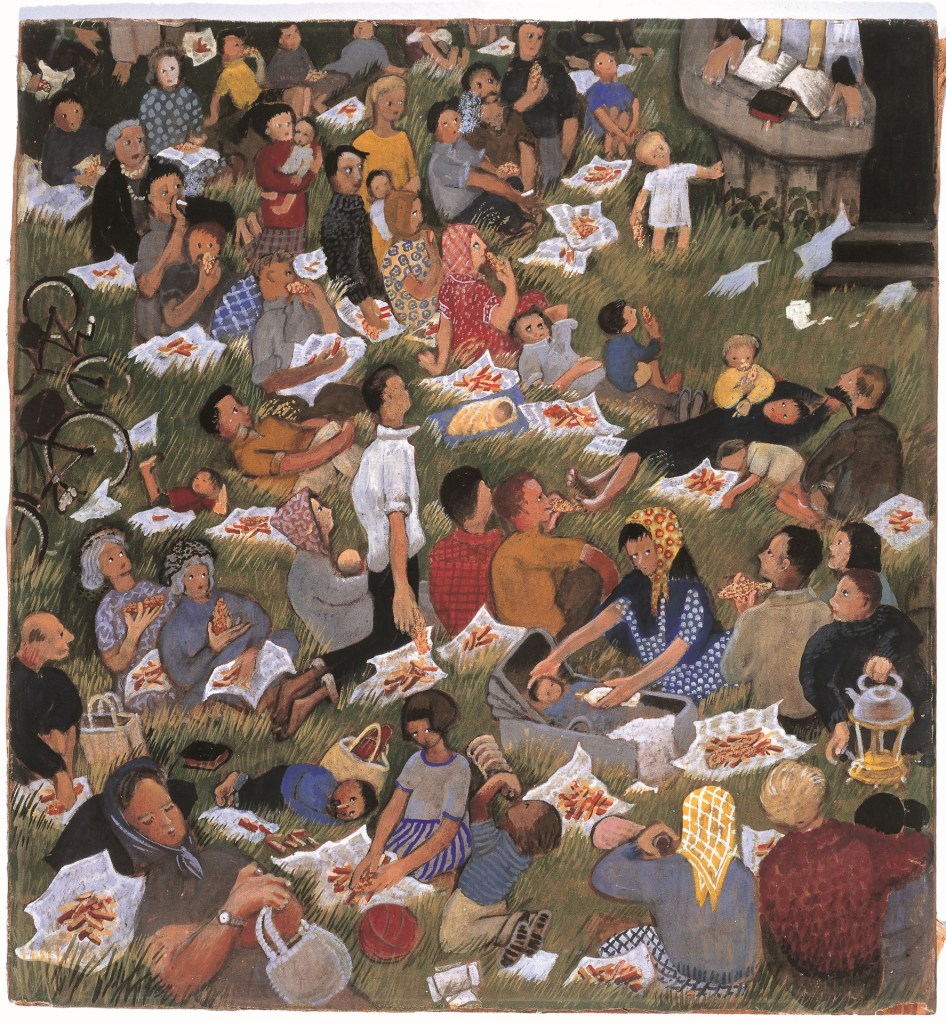
It is for me, and I assume from the title, a modern version of the feeding of the five thousand. It depicts a 1970s church outing with the congregation enjoying fish and chips whilst listening to an only partially visible preacher. A woman with a pearl necklace, a couple of men smoking, babies in carrycots, toddlers and children, a few people snoozing, most eating and listening to the preacher. The picture and the biblical story speak to me of the Kingdom of Heaven or in other words the value of community.
The story and the picture are for me a miracle of generosity and community spirit, rather than a metaphysical miracle – and no less a miracle for this. This is a miracle that we can still see today when people respond to need and genuinely share what they have. People generally want to help each other, and even more so when food is involved!
At Huddersfield Mission, we have recently had the opportunity to formalise some work that we have been doing for many years – supporting local communities. We have two staff who are using community interventions to tackle health inequalities. So, I ask myself what might Jesus and the story of the feeding of the five thousand tell us about community development.
The feeding of the five thousand starts by someone -in this case the disciples- seeing the need. Too often agencies, professionals and churches start with a solution- borrowed from Google or a book – this is the wrong place. Community work needs to start with people or as the mug on my desk reminds me: “It all starts with a brew.”
The disciples had a solution, but also made the problem one of resources – we need lots of money, they said. Jesus had a different approach, he understood the need and saw that the people already had the solution, but perhaps did not know it yet. This is an asset-based approach, rather than a deficit model. The Kingdom, time and time again is built on what communities already have. Let’s not simply assume that communities have problems and we, the church, has the magic answers to fill the gaps. Following Jesus is a much more active process than this. Community work cannot be done solely from a desk, and involves getting our hands dirty – or at least doing the washing up!
It is important to add here that an asset-based approach is not an excuse for saying that communities don’t need more resources, they do, but resources are only ever part of the solution. Asset Based Community Development is more about the attitude we have to people rather than resources.
Jesus’ solution was based on modelling positive behaviour and then involving everyone – those that came with nothing, and those that had enough to share, and everyone in between. Too much community development only involves the immediately willing, but real change needs to involve everyone. This is frighteningly difficult at times.
Perhaps Jesus could have ordered a huge takeaway for everyone via UberEATS, but the following day the poor would have been hungry again. Modelling the sharing of resources among everyone, shows a way of solving the problem for today and tomorrow. The best solutions always resolve the immediate issue and the underlying problem. Too often we are drawn to immediate solutions that at best are short term and at worse lead to dependency.
Jesus is often described as a fantastic story teller, and he was surely that, but to me he was also a brilliant community worker.
Finally seeing Eularia Clarke’s – The Five Thousand – for real reminded me just how little of the preacher is visible in the picture, and perhaps this is the last lesson for those of us grappling with community development – the story is not about us!
 Theology Everywhere