
by Philip Sudworth.
This year is 1700th anniversary of the Council of Nicaea of 325, which produced a creed, which is still recited regularly in many churches and acceptance of it is a requirement for membership and for ordination. The traditional church celebrates that this creed has remained largely unchanged over hundreds of years and sees this as mark of the unchanging nature of God.
In other aspects of knowledge and understanding, there have been huge developments over the 1700 years. The creeds have largely ignored most of those developments. Language has also moved on. I wonder how many of the people who recite the Nicene creed week by week fully understand what it is they are saying. “Seated at the right hand of the Father” rather suggests a medieval stained-glass window. To what extent do the words they recite reflect or conflict with their own perceptions and experiences of God?
Our children and our doctors, our rugby mates and our parents, our lovers and our lawyers will all see different sides of us. Yet that does not stop each of them having a genuine relationship with us, even if none of them know everything about us. Do we even know all there is to know about ourselves? If humans are too complex for us to know even ourselves fully, how much less can we even begin to comprehend the creative force that formed the billions of people and innumerable other life forms on this one small planet which orbits one of trillions of stars in an expanding universe that would take us 43 million years to cross travelling at the speed of light.
I suspect that the Trinity doctrine, as defined in the creeds, is an attempt to put a mind map, a structure on something infinitely more complex than we could ever hope to grasp – just as scientists talk about light as either particles or waves to enable them to calculate its effects.
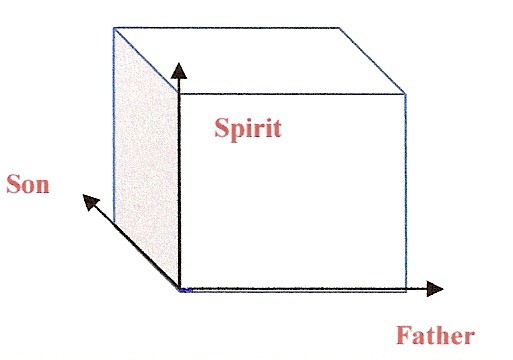
Perhaps, if we see the Trinity as dimensions of our individual experience of God, as in the diagram, then the interplay of relationships between the persons provide an infinite number of points or ways in which we can encounter God. One is just right for us personally at this phase of our faith journey.
I’ve been to church services that have focussed almost exclusively on the Spirit, several that have substituted Jesus for God throughout and others that have been totally Father-centred and ignored both Son and Spirit. We clearly need a better balance than this but the point of equilibrium is probably different for each of us. We can’t prescribe it for others. Indeed, our own perceptions are likely to change as we develop spiritually.
Although the Trinitarian theory of God, if interpreted in a broad rather than a dogmatic way, can allow for a variety of approaches to God, it may still be too limited for modern thinking. In their attempts to unify the fundamental physical forces under one single theory, scientists are now postulating that there are far more than three dimensions. Perhaps we ought to be open to the thought that God is more multi-facetted than just Trinitarian.
If “God is a Spirit and they that worship Him must worship Him in spirit and in truth” as Jesus said (John 4:24), then he is too fluid to be compartmentalised. You might as well stand in the sea off Cape Agulhas in South Africa where the Atlantic and Indian oceans merge and try to work out which water belongs to which ocean, as to try to divide up an omnipresent spirit God.
It is not how we define or describe God that matters but how we live in relation to him. Astronomers know that stars exist that they have not yet seen, because they can see the deviation in other stars and know that some as yet unseen body is exerting gravitational pull. People will know that God exists if they can see him transforming our lives. Christian witness is not about telling people of a God up in Heaven who will judge them when they die but about showing them a loving God who is active in the world right now. That way, we earn the right to share our faith.


Here is a poem I wrote.
MULTI –FACETED GOD Multi-faceted God, whose every surface Reflects the tones and colours In the wonder of creation. All the hues and shades of the longed for rainbow. Whose face always recognises mine.
Multi-lingual God, whose ears Recognise every timbre of tongue Of all the wonderful nations. All the rhythms and cadences Of the people of this Earth. Whose ear always hears my voice.
Multi-purpose God, who is my purpose; Reflecting the longings and desires Of all created people. All the needs and yearnings Of all whether young or old Who brings purpose to my life .
Multi-sensory God, who is finely tuned To those we have in the world. A sense of smell and hearing All the taste, sight and touch That we share with the Holy Mystery The God who senses every person.
Multi-inclusive God, embraces Her children, Black or white, male or female Lesbian, Gay, Bi-sexual , Transsexual or straight She holds out her arms to us This God who knows us all intimately
Multi-focused God, who is focused on us all Amazing God who looks on everyone Looks with every atom of his existence On every person in creation Concentrates on me and you and you And you and you and you This Holy Mystery who holds us all.
©Jo Kay Douai Abbey April 2013
Jo
LikeLiked by 1 person
I can’t remember now who it was that likened trying to describe the trinity as trying to put three billiard balls on one spot. For what it’s worth my concept of trinity is purely experiential and summed up in a drawing I made years ago: in a circle, on the outside is a maze, for God in himself, unknowable in himself, God unchanging, God faithful, his stability in himself. In the centre is a human foetus, symbolizing God’s moving out of himself, God vulnerable, God dynamic in outreach, God who develops our own spiritual growth. Underneath the foetus, and spreading its wings into the maze, is the Iona goose for the Holy Spirit, supporting, raising up ourselves and creation – and, yes even Jesus, the spirit-filled human who ‘took on’ the role of God in the world – towards God, flying where he wills. I don’t know if that helps others but I find it helpful, having had experiences that come from all three but are of the One. I don’t have to think in numbers or try to put God together, everything comes from the centre of God himself, and expresses something of how God works.
LikeLiked by 1 person
As Francis Young and others have shown, the Christian creed formation had a long history and finally had a political stamp. The controversy over the filioque clause and the seismic result of the Great Schism in the 11th cent continue to keep such a silly clause dividing the church. In the first place, it was a truncated creed as the primary revelation of God as YHWH and the Hebrew experiences and experiments and the continuation of the Jewish prophet Jesus ‘life, ministry and teaching (particularly on authority and leadership) had found no place in the creed. That is one of the reasons that some British missionaries to India and some well respected theologians of the Church of South India, refused to accept the classical creeds as adequate and advocated creation of a new creed. There have been attempts to create more comprehensive creeds. Also, apart from the political assertion of the half-baked affirmation of a small community, what is the significance of celebrating the 1700 years of the Nisean Creed? Since then, creative faith affirmations are created in the World Church where church life is flourishing while the political Christianity of Europe seems to be heading towards an extinction.
Israel
LikeLike